
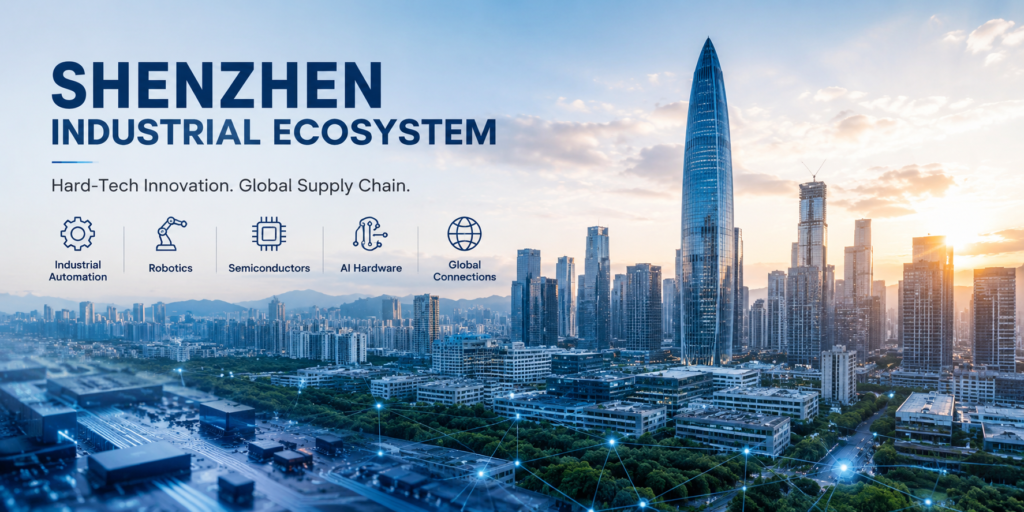
Shenzhen Is No Longer Just “The World’s Factory”
Over the past decade, Shenzhen has evolved from a low-cost manufacturing hub into one of the world’s most concentrated hard-tech ecosystems.
Today, Shenzhen plays a critical role in:
- industrial automation
- robotics
- AI hardware
- semiconductor electronics
- industrial PCs
- sensors and embedded systems
- rapid prototyping and hardware engineering
For global buyers, the city is no longer simply a sourcing destination.
It has become a strategic supply chain infrastructure center.
According to official government data, Shenzhen’s GDP exceeded RMB 3.6 trillion (USD 500+ billion) in 2025, making it one of China’s strongest industrial and technology economies.
Why Shenzhen’s Industrial Ecosystem Is Difficult to Replace
1. Extremely Dense Supply Chain Clusters
One of Shenzhen’s biggest advantages is supply chain density.
In many industrial zones:
- PCB manufacturers
- CNC machining workshops
- sensor suppliers
- automation component factories
- chip distributors
- injection molding suppliers
can all operate within a 30–50 km radius.
This dramatically reduces:
- procurement lead times
- engineering iteration cycles
- logistics costs
- product development delays
For industrial hardware companies, speed is often more valuable than labor cost savings.
2. Fast Prototyping Capability
Shenzhen’s engineering ecosystem is optimized for rapid iteration.
A hardware startup or industrial buyer can often:
- source components in Huaqiangbei
- modify PCB designs
- test firmware
- produce prototypes
- begin low-volume manufacturing
within days rather than months.
Compared with traditional manufacturing ecosystems, Shenzhen’s response speed is unusually high.
This is especially important for:
- robotics startups
- AI edge devices
- industrial IoT hardware
- embedded systems
- automation equipment
3. China’s Industrial Automation Sector Is Expanding Rapidly
Global demand for industrial automation continues to grow, especially in:
- the Middle East
- Eastern Europe
- Southeast Asia
- Africa
- Latin America
At the same time, many buyers are actively exploring alternatives to traditional European suppliers.
This includes demand for:
- PLC systems
- HMIs
- industrial control boards
- industrial PCs
- servo systems
- machine vision hardware
Chinese manufacturers are increasingly competitive in these categories.
Many factories now offer:
- OEM/ODM capability
- private-label manufacturing
- customized firmware
- flexible MOQ production
- rapid engineering support
This is one reason why China sourcing is shifting from low-cost procurement toward strategic industrial partnership models.
Shenzhen and the Rise of China Hard-Tech Manufacturing
China’s hard-tech sector has expanded significantly in:
- semiconductor packaging
- industrial electronics
- robotics
- AI infrastructure
- automation systems
- edge computing hardware
Shenzhen sits at the center of this ecosystem.
The city benefits from:
- mature export infrastructure
- deep electronics talent pools
- integrated supplier networks
- highly competitive manufacturing capabilities
For overseas companies, this creates opportunities to:
- reduce supply chain costs
- shorten development cycles
- localize manufacturing
- diversify industrial sourcing channels
Key Challenges International Buyers Still Face
Despite Shenzhen’s advantages, overseas buyers often encounter several problems:
| Challenge | Impact |
|---|---|
| Supplier quality inconsistency | Higher sourcing risk |
| Communication gaps | Engineering misunderstandings |
| Limited factory transparency | Difficult supplier verification |
| Technical compatibility issues | Integration failures |
| Logistics coordination complexity | Delivery delays |
This is why supplier evaluation and on-the-ground sourcing knowledge remain extremely important.
Industrial sourcing today is not only about finding factories.
It is about understanding ecosystems.
The Future of the Shenzhen Industrial Ecosystem
Over the next five years, Shenzhen is likely to remain one of the world’s most important industrial technology hubs.
Particularly in:
- industrial automation
- robotics
- AI hardware
- embedded electronics
- smart manufacturing
- semiconductor supply chains
As geopolitical competition reshapes global manufacturing, more companies are expected to build hybrid sourcing strategies involving China-based industrial ecosystems.
For many global buyers, Shenzhen is no longer optional infrastructure.
It is becoming part of long-term supply chain strategy.